INTERNATIONAL NEWS / ELEVATOR SAFETY & CODES
The Doors Were Installed. The Frames Were Never There.
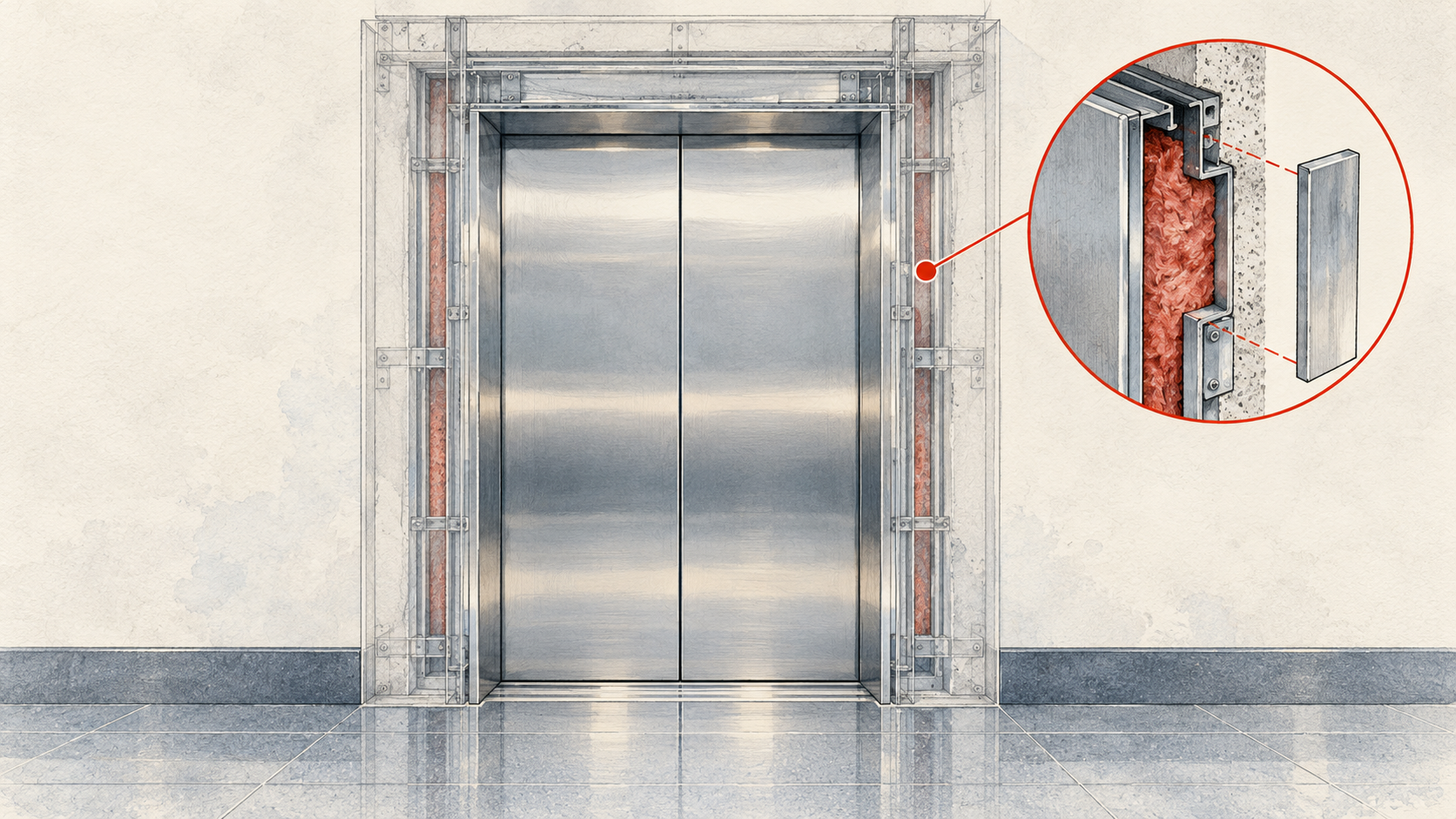
Hong Kong inspectors found fire-door certificates for complete door sets — and hundreds of buildings where part of the set simply did not exist. The case is a reminder that the most important part of a fire-protection system may be the part hidden behind the finished lobby.
In mid-October 2026, Hong Kong’s Electrical and Mechanical Services Department inspected lifts recently replaced by Taizoom Elevator Company. At two housing estates, inspectors found that fire-resisting doors had been installed but the corresponding door-frame components had not. The works had nevertheless been reported as complete.
EMSD then expanded the inspection. From October 16 through October 19, it checked 383 private buildings linked to the contractor. Missing frame components were reported in 338 of them. By October 23, inspectors had also sampled 150 buildings served by other registered lift contractors and reported no missing components in that sample.
The regulator referred the matter to police after saying that serious negligence or misconduct, fraud and false statements could not be ruled out. Those are allegations in an investigation, not findings of guilt. EMSD said the affected lifts could continue operating safely while repairs were completed under supervision.
Why the frame matters
A fire door is not just a shiny panel. A rated doorset is an assembly: door panel, frame, seals, hardware and the way the pieces meet the surrounding wall. The rating comes from testing a particular configuration. If a required component is absent, a certificate for a complete tested assembly does not prove that the incomplete installation has the same protection.
That is why the story matters outside Hong Kong. It is not an argument that every older frame must be replaced, or that panel-only work is automatically illegal. It is an argument for checking the approved configuration instead of relying on a label or a general description such as “new doors.”
What the Canadian code question actually is
Manitoba adopted ASME A17.1-2019/CSA B44:19 effective September 1, 2026. The standard describes an entrance assembly as a larger system that can include panels, frame, guides, sill, header and associated hardware. Section 2.11.14.1 also directs jurisdictions enforcing the National Building Code of Canada to the building code’s fire-protection requirements, including the CAN4-S104 door-assembly fire test, while the standard expressly limits the application of sections 2.11.14.2 through 2.11.18 in NBCC jurisdictions.
That qualification matters. It would be wrong to present every separate frame-label or installation provision in those sections as an automatic, universal Manitoba requirement. Compliance has to be established against the actual approved design, applicable building code, listed or certified configuration, installation details and the requirements of the authority having jurisdiction.
A replacement panel may sometimes be retained with an existing frame. It may also be unacceptable. The answer depends on whether the finished arrangement is approved and supported by the relevant technical evidence. A certificate does not install a missing piece of steel.
What owners should ask
- What is being replaced? Ask the quote to identify panels, frame components, seals and hardware — including what will remain.
- What approved configuration applies? Request the relevant fire-rating documentation, listing information and installation details for the building.
- How will the finished entrance be accepted? Confirm which inspection or acceptance record the authority having jurisdiction requires before final sign-off.
- Keep the records. Save the drawings, labels, certificates, inspection results and contractor correspondence with the service file.
Age is not the question. Compliance is. A complete, approved older entrance is one thing. A newly altered entrance missing a required part is another. The lesson from Hong Kong is simple enough for any building owner: fire protection is the part of an elevator you cannot judge by riding it.
Sources and verification
Hong Kong EMSD — sample check results for lift door-frame components
South China Morning Post — inspection results and photo by Elson Li
Manitoba Technical Safety materials on the September 1, 2026 regulatory transition and elevating-device enforcement; ASME A17.1-2019/CSA B44:19, including the entrance-assembly definition and §2.11.14.1.
This is general industry reporting, not an inspection procedure or an interpretation issued by Manitoba’s authority having jurisdiction. Read the licensed standard and applicable building-code provisions for a compliance decision.